
Key Takeaways
IQ scores reflect relative cognitive performance, but they do not fully explain how people think, adapt, decide, or perform over time.
IQ scores are measured relative to age groups, which is why the average remains 100 at every age.
Cognitive abilities such as memory, reasoning, and processing speed do not all change at the same rate over time.
Long-term performance depends not only on intelligence, but also on adaptability, judgement, consistency, and execution.
People often assume IQ changes in a clear upward or downward pattern across life. The reality is more complex.
IQ scores are designed to compare people within the same age group, not across different stages of life directly. This is why understanding average IQ by age requires looking beyond the numbers themselves and examining what IQ actually measures, how scores are calculated, and how cognitive performance changes over time.
What Is IQ and What Does It Measure
IQ, or intelligence quotient, is a score based on how well a person performs across different thinking and problem-solving tasks. Rather than measuring intelligence as one fixed ability, modern IQ tests assess several mental skills under controlled conditions.
These skills include logical reasoning, pattern recognition, working memory, verbal comprehension, and processing speed. Each reflects a different way people understand, interpret, and respond to information.
IQ scores are standardised against a reference group, meaning results reflect relative performance rather than an absolute measure of intelligence.
No single test can fully capture the complexity of human intelligence. IQ provides a useful estimate of certain mental abilities, but it is not a complete measure of how a person thinks or performs.

How Modern IQ Tests Are Structured
The Wechsler Adult Intelligence Scale is one of the most widely used IQ assessments. It produces a single score based on four areas: Verbal Comprehension, Perceptual Reasoning, Working Memory, and Processing Speed. Each represents a distinct cognitive function.
These abilities do not change at the same rate. A composite score can remain stable while its components shift. Verbal ability may improve with experience, while processing speed may decline. The overall score can remain unchanged, even though the underlying profile has changed.
Treating that total score as the full picture removes important detail about how those abilities differ.
How IQ Scores Are Calculated
Test results are based on performance across a range of tasks assessing abilities such as reasoning, memory, and processing speed. Raw scores are then standardised against a reference population and combined into a single composite score.
Earlier models used a ratio of mental age to chronological age, but this approach became unreliable beyond childhood and was eventually replaced by modern norm-referenced scoring methods.

Why the Average IQ Is 100 at Every Age
IQ scoring uses a norm-referenced system. Test results are compared within each age group, and the median score is set at 100. Scores above or below that point indicate how far a result sits from the group average.
The average IQ is therefore 100 at every age by design. It reflects how scores are distributed within each group, not a direct comparison of cognitive ability across different ages.
Normal IQ Range
Scores follow a standardised distribution centred on 100. Most results fall within a narrow range around this point.
IQ Score Range | Classification |
130 and above | Very high |
120 to 129 | High |
110 to 119 | Above average |
90 to 109 | Average |
80 to 89 | Below average |
70 to 79 | Borderline |
Below 70 | Low |
Most individuals score between 85 and 115, which represents the central range of the distribution.
These classifications apply within each age group and do not support direct comparison across ages.
Reported IQ Differences Across Age Groups
Some studies report differences in test performance across age groups. Large-scale research, including work on the Flynn Effect, has shown changes in results over time. These findings are valid, but they reflect generational shifts rather than changes within individuals.
Attempts to compare results across age groups using standardised IQ scores can be misleading. Outcomes are influenced by factors such as sample bias, familiarity with the test, health differences, and broader population effects. This makes it difficult to isolate true developmental change.
What These Differences Actually Reflect
Observed variation in raw cognitive performance arises from several distinct factors:
Test calibration choices that favour certain cognitive styles
Generational influences linked to education and environment
Biological changes in mental skills, such as speed of thinking and memory
These factors do not form a single trend. Treating them as one leads to conclusions the data does not support.

How Cognitive Abilities Change Across the Lifespan
Different thinking abilities change in different ways over time. Some abilities decline, others improve, and overall performance depends on how these changes interact. The key distinction is between fluid intelligence, which tends to decline, and crystallised intelligence, which continues to develop.
Fluid Intelligence and Early Peak Performance
The ability to solve new problems, adapt quickly, and reason abstractly tends to peak in early adulthood and decline gradually thereafter. The extent of this decline is often overstated, as reduced processing speed does not directly limit effectiveness when supported by experience and structured thinking.
Crystallised Intelligence and Knowledge Accumulation
The use of accumulated knowledge and experience follows a different trajectory. It continues to develop into later adulthood and remains relatively stable, forming the basis of expertise and often offsetting declines in other areas.
Processing Speed and Memory Over Time
Processing speed declines earliest, with gradual reductions in working memory over time. Individuals compensate through more efficient strategies, reducing impact on real-world performance.

What IQ Scores Do and Do Not Predict
Predictive value is strongest in structured environments. Scores correlate with academic performance and tasks that rely on reasoning, memory, and processing speed. At a population level, they show some correlation with occupational outcomes.
What IQ scores can predict:
Performance in formal education
Ability to solve structured, analytical problems
Outcomes in roles that rely on cognitive processing
What IQ scores do not predict:
Performance under pressure
Decision-making in uncertain or ambiguous situations
Consistency of execution over time
Ability to manage relationships or lead effectively
The gap between potential and results depends on how ability is actually used. Consistency, emotional control, and decision-making determine results, and these are not captured by IQ.
This distinction is reflected in Brad Lea’s discussion on discipline, habits, and long-term success, where consistent execution is presented as more important than potential alone.
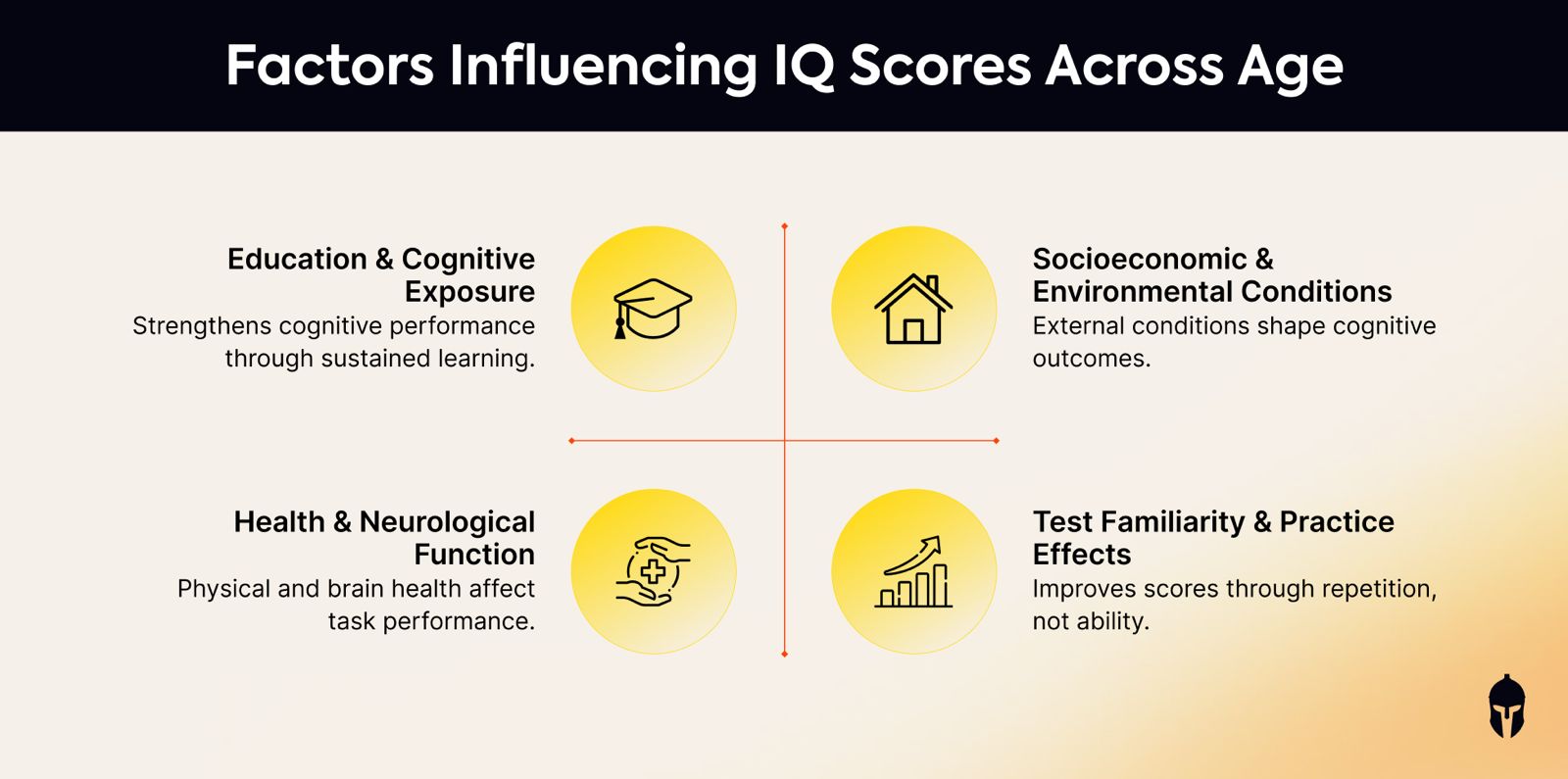
Factors That Influence IQ Scores Across Age
IQ scores are shaped by a range of external and physiological factors. They reflect a combination of underlying capacity and current conditions, not a fixed level of ability.
Key influences include:
Education and cognitive exposure: sustained learning and mentally demanding work strengthen specific functions. Increases in test scores over time are largely linked to changes in education, environment, and access to information.
Socioeconomic and environmental conditions: chronic stress, poverty, and exposure to toxins can suppress performance. When these factors are controlled, many reported differences in scores are reduced or disappear.
Health and neurological function: sleep quality, physical health, and overall brain function affect how well tasks are performed. Scores often reflect current condition as much as underlying ability.
Test familiarity and practice effects: repeated exposure improves results through familiarity, not actual improvement in ability.
These factors interact with each other. Interpreting IQ scores without accounting for them leads to incomplete conclusions.
Can IQ Change Over Time?
Scores tend to remain stable across adulthood, as they reflect performance relative to a same-age group. Significant shifts are rare outside of neurological events or major changes in how the brain is used.
Specific skills such as memory, attention, and processing speed can improve with training, but these gains do not consistently raise the overall score.
Changes in performance are more often driven by how effectively ability is applied rather than changes in the score itself.

A More Accurate Way to Understand Intelligence Over Time
Intelligence is not a single score. It is the interaction between cognitive ability, behavioural execution, and adaptability. IQ reflects part of this system, but it does not capture how consistently that ability is applied or how effectively it adjusts to changing conditions.
Outcomes depend on how thinking translates into action. The ability to apply structured reasoning under pressure, make decisions, and follow through consistently determines performance. This is what separates potential from results, and it is not measured by IQ.
René Rodriguez highlights this in his discussion on performance under pressure, where skill development is driven by adaptation and exposure rather than initial ability.
Why Performance Outweighs Measurement
The most meaningful measure of cognitive ability is not a score. It is the quality of outcomes produced over time in real conditions. A sustained record of sound decisions, effective learning, and consistent execution provides a clearer measure of functional intelligence than any single assessment, including interpretations of average IQ by age.
IQ is a starting point, not a conclusion. Understanding what it measures, what it misses, and how cognition evolves over time is foundational to building a mind that performs when it matters.
Frequently Asked Questions