
Key Takeaways
An effective morning routine is not about doing more habits. It is about creating structure that improves focus, decisions, and consistency throughout the day.
Morning routines fail when they are built around imitation, too many habits, or the appearance of productivity instead of real results.
High-impact routines rely on consistency, simple structure, and actions that reduce distraction and improve clarity early in the day.
Long-term effectiveness comes from adapting the routine to real-life demands while maintaining the core habits that support focus and execution.
Most people build a morning routine by copying someone else’s. They see a schedule such as early wake-up, meditation, and journaling, and try to follow it without understanding why it works for that person or whether it fits their own situation.
The routine usually becomes difficult to sustain. What starts as structure turns into friction, and consistency breaks down. In most cases, the problem is not the idea of a morning routine itself, but how the routine was designed in the first place.
What a Morning Routine Is Designed to Do
Before choosing any habits, it helps to understand what a morning routine is for. It is not just about starting early or doing more. It is about shaping how you think and act during the rest of the day.
In the first hour, the mind is more affected by what it takes in. Without structure, that time is often filled with external input such as messages, email, or news. This creates a reactive state that tends to carry through the day.
A well-designed routine does the opposite. It reduces mental noise, creates a stable starting point, and gives you direction before external demands take over. Early actions set the direction for everything that follows. A focused start builds momentum, while a fragmented start makes the rest of the day harder to manage.

Why Most Morning Routines Fail to Produce Results
The problem is structural, not motivational. Most routines fail for three reasons.
The first is imitation without context. A routine that works for someone with few constraints will not work the same way for someone balancing multiple responsibilities. Habits may be effective on their own, but without fitting your actual situation, they become difficult to sustain.
The second is overloading with low-impact activity. Many routines include too many habits, creating long sequences that are hard to maintain. More actions do not produce better results. Volume is not the same as value.
The third is confusing activity with effectiveness. A morning routine is not about doing more. It is meant to improve how you operate during the day. If it does not improve your focus, decisions, or output, it is not working.
Key Principles Behind an Effective Morning Routine
Four principles guide how an effective morning routine is built.
Consistency matters more than content: repeating the same sequence daily reduces decision-making and makes the routine easier to follow.
Fewer habits improve consistency: a short routine done every day is more effective than a long one done occasionally.
Sequence shapes the day: what you do first affects the state you carry into the rest of the day.
Focus on high-impact actions: include habits that improve thinking, focus, and decisions, not just those that create the feeling of effort.

What Makes a Routine Sustainable
A sustainable routine works because it reduces friction, supports consistency, and fits the demands of real daily life.
Fewer, High-Impact Actions
Adding more habits increases the effort required to complete the routine. As effort increases, consistency drops. The goal is to focus on a small number of actions that have the strongest effect on how you approach your work and decisions.
Sequence Shapes Behaviour
The order of actions changes how the routine works. Movement can increase alertness. Stillness can reduce noise before decisions. Defining priorities early sets direction before external demands take over. The sequence determines the state you carry into the rest of the day.
Alignment With Real Constraints
A routine must fit your actual schedule. If it requires more time or energy than you consistently have, it will not last. Build it around your available time and adjust as your situation changes.
Consistency Over Intensity
A short routine done daily is more effective than a long one done occasionally. Repetition builds automatic behaviour, which reduces reliance on motivation and makes the routine easier to maintain.
This principle is reflected in Jeff Smith’s discussion on long-term success, where consistent repetition and following the right steps matter more than short bursts of effort or luck.
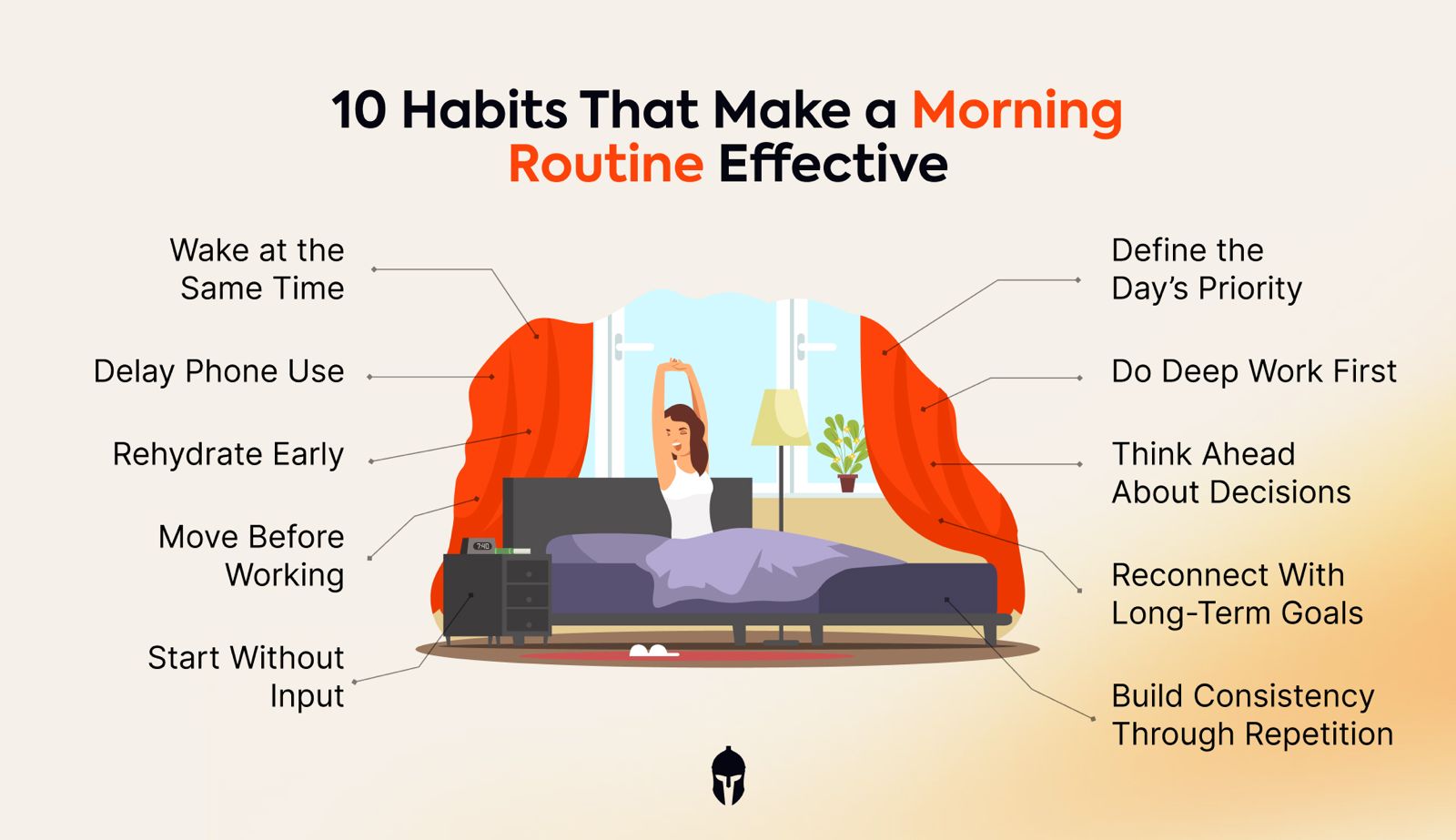
10 Habits That Make a Morning Routine Effective
These habits are designed to improve how you think, decide, and act during the day. Focus on applying a few well rather than trying to do all of them at once.
1. Wake at the Same Time Every Day
Waking at different times each day disrupts your internal rhythm and makes it harder to maintain consistent energy and focus. A fixed wake time stabilises that rhythm and gives your day a predictable starting point.
Over time, this reduces the effort required to begin. You are not deciding whether to start. You are following a pattern that is already in place.
2. Avoid Your Phone First Thing
Checking your phone immediately shifts your attention to external demands. Messages, updates, and notifications pull you into response mode before you have set your own direction. Once the day begins this way, it often continues the same way. Delaying phone use helps you start from a position of control instead of reaction.
3. Drink Water Early
After several hours of sleep, your body is naturally dehydrated. Even mild dehydration affects attention, memory, and processing speed. Drinking water early restores your baseline. Without this, you begin the day operating below your normal level without realising it.

4. Move Your Body Briefly
A short period of movement increases alertness and prepares your body for activity. This does not require a full workout. It creates a clear shift from rest to action, making it easier to engage with work instead of easing into distraction.
5. Spend Time Without Input
A few minutes without screens, noise, or stimulation reduces mental clutter. This gives you a clearer starting point for decisions. Without this pause, your attention is immediately filled, and your decisions are shaped by whatever comes in first.
This becomes harder in environments built around constant stimulation and distraction. Dave Crane discusses how constant connectivity, social media, and information overload can increase reactivity and make it harder to think clearly.
6. Decide What Matters Most Today
Before engaging with anything else, define the one outcome that would make the day worthwhile. This prevents your effort from being spread across multiple tasks that feel urgent but lack impact. It gives your day a clear direction from the start.
7. Start With Your Most Demanding Work
Your ability to focus is strongest early in the day. Use this time for work that requires sustained attention, not for tasks that require only response. If this window is used on low-value work, the rest of the day becomes a recovery from lost focus.
8. Think Ahead About Key Decisions
Consider the decisions you are likely to face. Thinking about them early allows you to respond with more clarity later. Without this, decisions are made under pressure, where judgement is more likely to be rushed or influenced by emotion.
This becomes especially important in uncertain environments. Sean Allison speaks about how structured systems help reduce emotionally driven decisions in high-pressure situations.
9. Reconnect With Long-Term Goals
Spending a few minutes reviewing your longer-term priorities keeps your actions aligned with where you want to go. Without this, it is easy to stay busy while gradually moving away from what matters.
10. Show Up Consistently
The routine works through repetition, not perfection. What matters is returning to it each day.
Consistency reduces reliance on motivation and turns the routine into something automatic rather than something you have to force.
Kris Fade speaks about how routine, consistency, and showing up daily became the foundation for maintaining performance and managing pressure in a demanding industry.

How to Build a Routine That Actually Sticks
A routine does not need to include everything at once. Begin with two or three habits that you can complete without effort or resistance. The goal early on is not coverage, but reliability. A small routine done daily builds a stronger foundation than a longer one that is difficult to maintain.
Once the routine becomes stable, it can be expanded carefully. Add new elements only when the current version feels automatic and no longer requires deliberate effort. The design should also reduce friction as much as possible. This means:
Preparing what you need the night before
Keeping the routine simple to start
Removing distractions that interrupt the flow
The effectiveness of the routine should be judged by what happens after it. If your focus, decisions, and output improve during the day, the routine is working. If not, it needs adjustment. Track how your day unfolds and refine the routine based on results, not assumptions.
Common Mistakes That Undermine Morning Routines
Many routines break down not because the idea is wrong, but because of how they are built and used.
One common mistake is adding too much too quickly. A routine designed to feel impressive often becomes difficult to complete. When the routine itself requires more effort than the day it is meant to prepare you for, it stops working.
Another mistake is focusing on identity instead of results. Building a routine to feel disciplined or productive does not guarantee it improves how you actually think and act. What matters is whether it makes your day better, not how it looks.
Ignoring real-life constraints is another problem. A routine that works when your schedule is light may not hold when demands increase. If it cannot adapt, it will break under pressure.
Consistency is what makes the routine effective. Without repetition, even a well-designed routine produces little change. The goal is not occasional perfection, but steady execution.
Adapting Your Routine Without Losing Structure
A routine should not break when your day changes. It should adjust while keeping its core function intact.
Different situations require small changes, not complete resets:
On high-pressure days: reduce the routine to two or three key habits instead of skipping it completely. A shorter version maintains structure and keeps the day from becoming reactive.
During low-energy periods: focus on lighter actions that support recovery rather than performance. The goal is to keep the habit in place, even if the intensity changes
When schedules are disrupted: use a minimal version that can be done anywhere. This makes it easier to stay consistent despite travel or unexpected demands.
Keeping a routine flexible prevents it from breaking under pressure. The structure remains, even when the content changes.
Why a Morning Routine for Success Works
A morning routine is not just a set of habits. It creates the conditions for how the day unfolds. A reactive start often leads to a reactive day. A structured start makes decisions and actions more controlled.
The goal is not to rely on motivation. It is to build a routine that works even when you do not feel like doing it. When repeated consistently, the routine becomes automatic and requires less effort to maintain. This is what makes it effective over time.
Frequently Asked Questions