
Key Takeaways
Empathy and sympathy may appear similar, but they affect understanding, communication, and decision-making in very different ways.
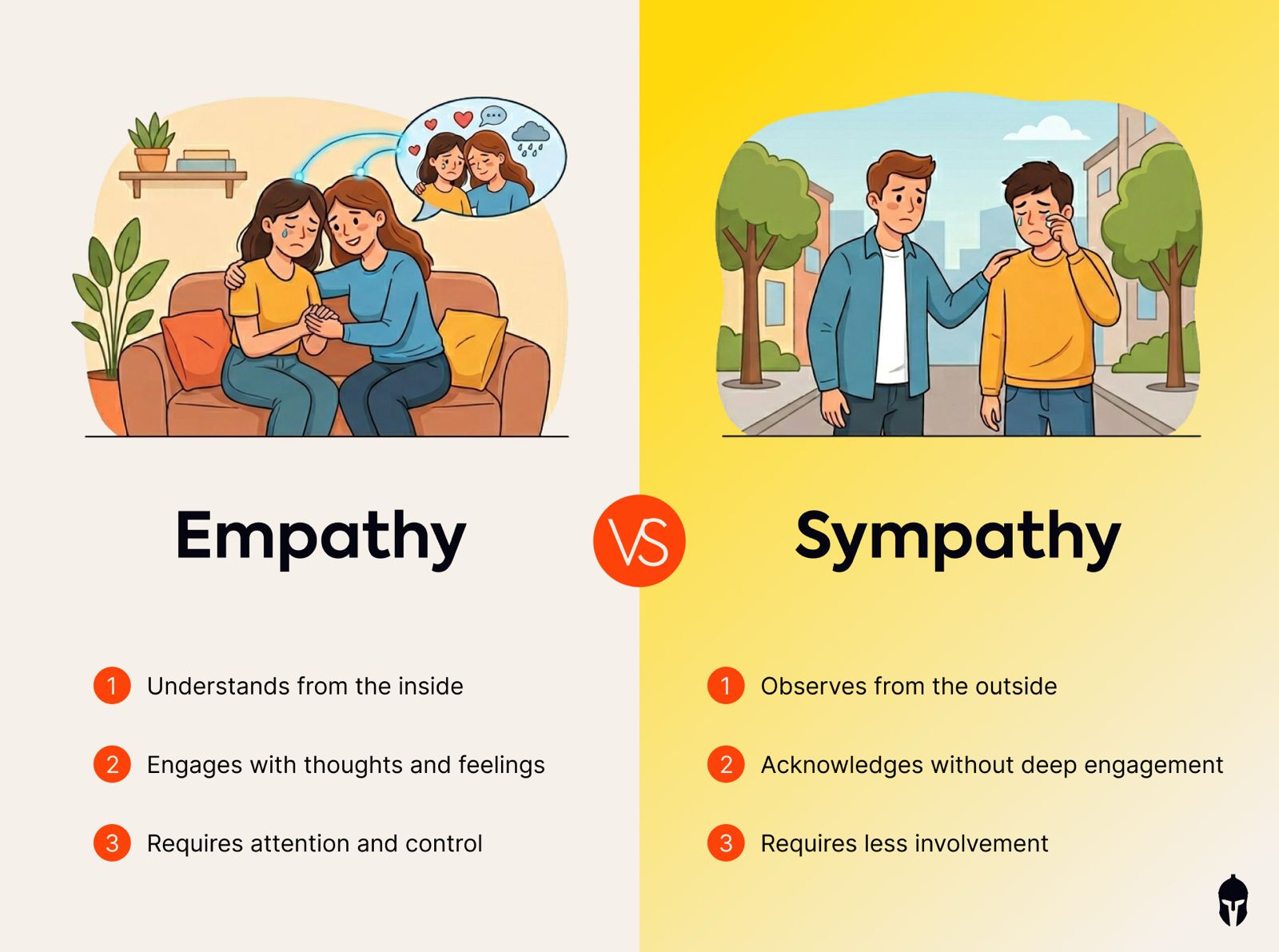
Empathy involves understanding another person’s experience from within, while sympathy acknowledges it from a distance.
Using the wrong response in high-pressure situations can weaken trust, reduce clarity, and lead to poor judgement.
Effective communication depends on recognising what the situation requires, balancing understanding with objectivity, and responding with the right level of action.
These terms are often treated as interchangeable, particularly when empathy and sympathy are not clearly understood. Each describes a different psychological process, and applying the wrong one in a high-stakes moment often leads to a worse outcome than saying nothing.
The distinction is operational. In leadership, negotiation, and any environment where judgement determines results, it affects how accurately situations are understood and how effectively decisions are made.
What Is Empathy
The ability to understand another person’s perspective from within their experience defines empathy. It means recognising how a situation feels to them, not just observing it from the outside.
It involves two related capacities:
Recognising what someone is likely thinking and why
Sensing what that experience feels like at an emotional level
Both require attention and control. Effective use depends on staying aware of the other person’s perspective without losing your own. Without that control, empathy shifts into over-identification, where emotional involvement reduces objectivity and weakens judgement.
What Is Sympathy
The recognition of another person’s difficulty without entering their experience defines sympathy. It maintains distance while acknowledging that something is wrong.
It typically involves:
Recognising that someone is facing a problem
Expressing concern or acknowledgement
Maintaining separation between their experience and your own
This makes it useful in situations where acknowledgement is enough, or where deeper engagement is not possible. Its limitation appears when it replaces understanding, especially in situations that require accurate interpretation rather than a surface response.
Why Confusing Empathy and Sympathy Leads to Poor Judgement
Confusing these concepts leads to responses that do not fit the situation. When sympathy is used where empathy is needed, the person feels acknowledged but not understood. The conversation ends without clarity, trust does not deepen, and the issue remains unresolved. When empathy is applied without control and emotions are absorbed instead of understood, objectivity declines and decisions become less accurate.
In high-pressure environments, this misreading leads to clear failures. It creates incorrect assumptions, weakens communication, and produces blind spots in judgement when accuracy matters most. Accuracy in emotional response is a performance variable. It separates effective leaders from well-intentioned ones.
Empathy vs Sympathy: The Core Differences
The difference between empathy and sympathy comes down to how each engages with another person’s experience, the level of involvement required, and the effect on the interaction.
Aspect | Empathy | Sympathy |
Internal experience | Understands the situation from the inside | Observes the situation from the outside |
Level of engagement | Active interpretation and adjustment | Passive recognition |
Effect on the other person | Reduces isolation through understanding | Provides acknowledgement but maintains distance |
Cognitive demand | Requires attention, perspective-taking, and regulation | Requires less cognitive effort |
Empathy requires active processing and control. Sympathy requires recognition without the same level of involvement.
This distinction is often misunderstood in practice. In a discussion on empathy in leadership, Dariush Soudi and Mimi Nicklin describe what is often seen as an “empathy deficit” not as strength, but as a failure to understand people accurately.

Empathy vs Sympathy vs Compassion: What Sets Them Apart
Compassion adds a third element that empathy and sympathy do not provide: action.
Empathy produces understanding. Sympathy provides acknowledgement. Compassion moves from understanding to action.
In leadership, this difference is clear. A team member struggling with workload may receive sympathy through reassurance or empathy through understanding of pressure. Compassion goes further. It identifies the constraint and adjusts the workload or support.
Confusing these responses leads to poor outcomes. Sympathy alone can close a conversation too early, leaving the problem unchanged. Empathy without action creates understanding that does not lead to results. Compassion without understanding leads to action that misses the actual need.
Outcomes depend on sequence: understanding accurately, acknowledging honestly, and acting precisely.
How Each Affects Decision-Making and Performance
These differences become clear in how decisions are made under pressure.

Empathy in Decision-Making
In negotiation, leadership conversations, and conflict, empathy improves how accurately you understand the other party’s position, motivations, and constraints. Better understanding leads to better decisions.
A negotiator who understands what the other party truly values is working with better information than one who only hears what is said.
The risk is bias. If empathy is not controlled, you may align too closely with the other perspective. This weakens your ability to assess the situation clearly. Use empathy as input, then step back before deciding.
Sympathy and Emotional Control in Decisions
Sympathy can close conversations too quickly. The instinct to reassure is strong, but reassurance given too early resolves discomfort rather than the problem.
This leads to:
Decisions based on incomplete information
Unresolved issues
Responses that appear supportive but lack depth
This becomes more critical under pressure. As discussed by René Rodriguez in the context of performance under pressure, communication and judgement depend on the ability to maintain clarity whilst managing emotional intensity.
Real-World Applications: When Empathy and Sympathy Are Effective
Effectiveness depends on matching the response to the situation.
Situations That Require Empathy
Conflict resolution depends on identifying the underlying issue, not just the surface problem. Leadership conversations about performance, direction, or difficult feedback rely on understanding to be accepted rather than resisted. In negotiation, empathy helps reveal the gap between stated positions and underlying interests.

Situations Where Sympathy Is More Appropriate
In moments of emotional overload, acknowledgement is more useful than deeper engagement. Initial responses to loss, shock, or crisis often require recognition rather than perspective-sharing. In time-constrained environments, where sustained engagement is not possible, sympathy provides a direct and appropriate response.
Transitioning Between the Two
Effective communicators adjust based on what the situation requires. When conversation shifts from expression to problem-solving, the response should shift with it. As distress stabilises, deeper engagement becomes possible. Recognising these changes and responding accordingly separates deliberate judgement from automatic reaction.
Common Mistakes in Using Empathy and Sympathy
Errors in application reduce clarity, weaken trust, and lead to poor decisions.
Over-identification: understanding turns into emotional absorption, reducing objectivity and usefulness.
Detached responses: sympathy without genuine engagement feels insincere and can damage trust more than silence.
Confusing understanding with agreement: recognising a perspective does not require endorsing it, and failing to separate the two limits information and influence.

How to Develop Empathy Without Losing Objectivity
Developing empathy starts with listening for meaning, not just words. Focus on what the person is pointing to, not only what they say. This means identifying underlying concerns such as assumptions, pressure, or priorities instead of reacting to surface statements.
Maintaining objectivity depends on control. Notice when your emotional state begins to shift and decide how far to engage with it. Use that information to guide your judgement, then step back before acting. Effective empathy leads to clear action. If insight does not change your decisions, it is incomplete.
A More Useful Way to Apply This
Emotional signals are only useful when they improve decisions. Treat them as input, not something to absorb or act on automatically.
What matters is how that input translates into behaviour. Accurate interpretation, followed by controlled action, leads to better outcomes. This is where emotional awareness becomes a performance variable.
Empathy vs Sympathy: Why Accuracy in Response Matters
Most interpersonal misjudgements are not caused by lack of care, but by lack of accuracy. Misreading what a situation requires, whether offering sympathy instead of empathy or action instead of understanding, leads to outcomes that do not match intent.
Improvement comes from recognising what the situation requires and delivering the appropriate response. This turns emotional awareness into a practical capability, built through attention, practice, and honest self-assessment.
Frequently Asked Questions