
Key Takeaways
Instinct is not random or mystical. It is a fast response shaped by biology, experience, and repeated exposure to patterns over time.
Instinct works best in familiar situations where experience and feedback have built reliable pattern recognition.
Emotional reactions such as fear or overconfidence can feel like instinct, but they often lead to poor judgement when left unchecked.
Strong decision-making depends on balancing instinct with analysis, especially in high-pressure or unfamiliar situations.
The word instinct is widely used but rarely examined. It appears in boardrooms, in sport, and in everyday advice, yet most people cannot explain what it is, where it comes from, and when it can be trusted.
Without that understanding, decisions rely on guesswork. People follow instinct when it should be questioned and ignore it when it could be useful. This leads to repeated errors in judgement.
Instinct Meaning: What It Actually Refers To
It is a fast response based on pattern recognition built from past experience. It happens without deliberate reasoning, but its accuracy depends on how well those patterns match the situation.
In simple terms, instinct allows you to respond before conscious analysis is complete. This speed is useful when time is limited, but it also means the response is not checked.
These responses are not random. They come from stored patterns built through repeated exposure and linked to outcomes. When a situation matches one of those patterns, the brain produces a response automatically.
This is why instinct can feel reliable in familiar situations and unreliable in new ones. Its quality reflects the experience behind it.
Why Instinct Is Often Misunderstood
Two common mistakes shape how instinct is viewed. One is uncritical trust, where instinct is treated as reliable guidance that should be followed without question. The other is dismissal, where it is seen as nothing more than an emotional reaction.
Both views are incomplete. Instinct is neither random nor inherently reliable. It is a fast response shaped by experience and pattern recognition. Its accuracy depends on the quality of those patterns.

How Instinct Actually Works
These responses are produced by specific processes in the brain that combine speed with stored experience.
Immediate, Non-Conscious Response
Instinct produces rapid responses without deliberate reasoning. It is triggered by external situations or internal cues and generates a reaction faster than conscious analysis.
This speed is its main advantage. In situations where delay has a cost, fast responses are useful. The key question is what that response is based on.
Biological and Learned Components
Some instinctive responses are biological, such as threat detection or withdrawal from danger. These are present from birth and shared across people.
Others are learned. As you gain experience, the brain stores patterns and links them to outcomes. When a similar situation appears, it triggers a response based on that stored experience. This is why experienced professionals can respond quickly without needing to think through every step.
Most definitions focus only on instinct as a natural or innate response. This captures the biological side but ignores the learned component. In reality, instinct is not fixed. It develops through experience and improves with feedback.
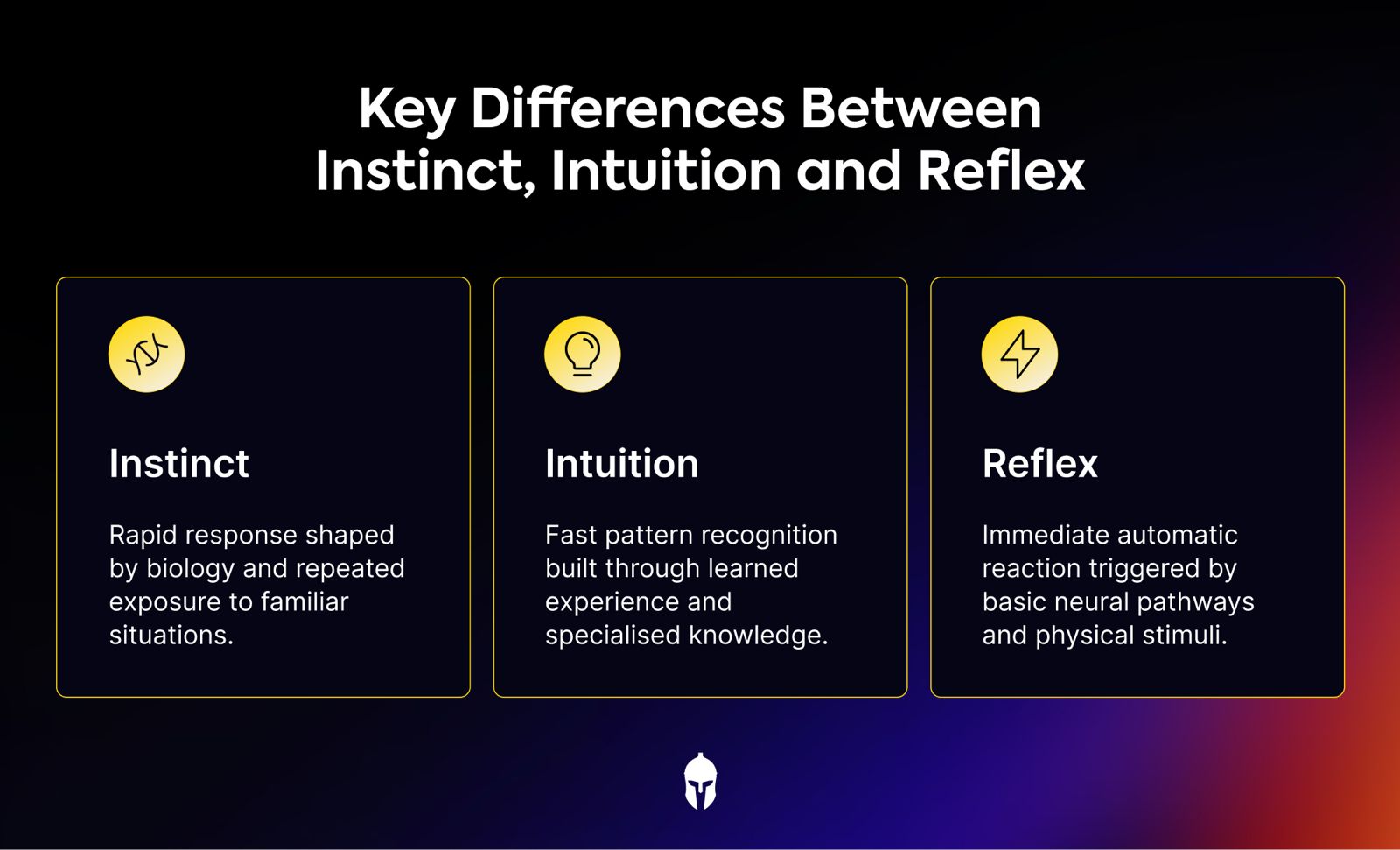
Instinct vs Intuition vs Reflex
These terms are often used interchangeably, but they describe different types of responses.
Instinct vs Reflex
A reflex is a simple, automatic response to a specific stimulus, such as pulling your hand away from heat or reacting to bright light. It happens immediately and does not involve interpretation.
Instinct is more complex. It produces a response based on a wider set of inputs and often includes pattern recognition, even when that process happens outside conscious awareness.
Instinct vs Intuition
Instinct refers to responses with biological roots that operate across people. Intuition is based on personal experience.
Intuition develops as you build knowledge in a domain. It reflects patterns learned over time and applied quickly, without conscious effort.
In practice, what many people call instinct is often intuition. An experienced professional responding quickly within a known context is using learned patterns, not just a basic instinct.

Why Confusing These Leads to Poor Decisions
Confusion between these responses leads to errors. Emotional reactions such as fear, anxiety, or overconfidence can feel like instinct but are not based on reliable patterns.
When you treat these signals as instinct, you act without checking their source. This leads to confident decisions that are not well grounded.
In practice, this means pausing briefly and asking whether the response comes from experience or from immediate emotion.
How Instinct Works in the Brain
Incoming information is continuously matched against stored patterns built from past experience. When a match is found, it triggers a response without deliberate reasoning. This appears as a feeling, impulse, or shift in attention, and it happens quickly, alongside conscious thought rather than after it. The quality of this response depends on the quality of the stored patterns. Accurate, well-tested patterns produce reliable responses, while weak or outdated patterns do not.
This process relies on fast systems that assess situations before full analysis is complete. Emotional signals are assigned early, which is why instinct often feels urgent. The advantage is speed. The trade-off is accuracy. In familiar situations, this leads to effective decisions. In unfamiliar ones, the same speed can lead to errors because the response is not verified.
Types of Instinct and Their Function
Instinctive responses can be grouped based on the problems they evolved to solve.
Survival Instincts
Responses focused on detecting and reacting to threat form the basis of survival instincts. These include fight-or-flight reactions and rapid assessment of physical danger. They operate automatically and remain active regardless of conscious reasoning.
Social Instincts
How you assess and respond to others is shaped by social instincts. They influence perceptions of trust, belonging, and social risk. These responses develop through both biology and experience.
Reproductive and Drive-Based Instincts
Motivation, energy use, and goal-directed behaviour are influenced by reproductive and drive-based instincts. They shape actions that are often not consciously analysed and can override purely logical decisions.
The Role of Instinct in Decision-Making
When time is limited and delay has a cost, instinct allows you to respond faster than deliberate analysis. In emergencies, competitive settings, and high-stakes decisions, this speed can be an advantage. The response is not random. It is based on patterns formed through experience, which is why experienced individuals can act quickly with direction while others hesitate.
The value of instinct depends on how well those patterns match the situation. It works best in familiar environments where similar conditions repeat and feedback has been clear enough to refine judgement over time. In these cases, instinct reflects accumulated experience applied at speed. When those conditions are absent, the same response becomes less reliable.
When Instinct Leads to Poor Judgement
Instinct becomes unreliable when the underlying patterns are weak, misapplied, or driven by emotion rather than experience.
Misapplied patterns: responses rely on familiar templates that do not match the current situation, leading to confident but incorrect decisions.
Emotional signals mistaken for instinct: fear, anxiety, and overconfidence create strong internal reactions that feel reliable but are not based on accurate patterns.
This becomes especially visible in environments shaped by uncertainty and pressure. In discussions on trading psychology and financial decision-making, Sean Allison explains how disciplined systems help reduce the influence of emotion on decision-making.
Lack of experience: limited exposure and weak feedback produce shallow pattern recognition, making instinct unreliable in unfamiliar situations.
Instinct and Rational Thinking Are Not Opposites
Instinct and analysis work together in effective decision-making. Instinct provides direction based on past experience, while analysis checks whether that direction is valid. Relying on instinct alone leads to confident errors. Relying only on analysis leads to slow decisions that may miss critical timing.
The key is knowing when to verify. In high-risk or unfamiliar situations, instinct should be tested rather than followed immediately. Strong signals are not always reliable. The goal is awareness: recognise when a response is instinctive, assess its likely basis, and decide whether to act on it or pause. This is not about suppressing instinct, but using it with control.
Developing Better Instinct Through Experience
Instinct improves through repeated exposure to real situations. As you engage in a domain, the brain builds patterns based on results. The depth of those patterns depends on the quality of experience, not just the amount. Environments with clear stakes and real consequences develop stronger instinct than those without.
Feedback is essential. Without accurate feedback, patterns become distorted and instinct becomes unreliable. Improving instinct also requires separating experience from emotion. In practice, this means pausing to assess whether a response is based on past learning or immediate reaction. Over time, this builds more reliable judgement.

A More Accurate Way to Understand Instinct
Instinct is not separate from experience, and it does not oppose reasoning. It is experience applied quickly. The response comes from patterns built through exposure and shaped by feedback. When understood this way, instinct is not something to trust or ignore, but something to develop.
Decision quality depends on how well instinct and analysis are used together. Instinct provides direction, while analysis checks whether that direction is valid. The goal is not speed, but the quality of the outcome. Strong decisions come from knowing when to act and when to verify.
Why Calibrated Judgement Determines Outcomes
Under pressure, decision quality depends on how well instinct has been shaped by experience and feedback. Those who develop this alignment consistently outperform both those who overanalyse and those who act without reflection. Effective judgement is not about choosing between instinct and reasoning. It is about aligning instinct with analysis.
This becomes more critical in high-pressure conditions, where emotion, fatigue, and uncertainty distort perception. Mostafa Salameh speaks about the importance of maintaining clarity and discipline when conditions become extreme.
This alignment is what defines calibrated judgement. It is not found or assumed. It is built through repeated exposure, honest feedback, and deliberate correction over time.
Frequently Asked Questions