
Key Takeaways
Meaningful interaction usually begins when pressure decreases and attention shifts towards the other person rather than towards managing impressions.
Natural conversations rely more on comfort, curiosity, and responsiveness than perfect wording or rehearsed lines.
Most awkwardness comes from overthinking, rushing, or trying too hard to control the exchange.
Social confidence improves through repeated practice, attention, and becoming more comfortable with uncertainty.
Most people think starting a conversation is a confidence problem. Either you can walk into a room and connect easily, or you cannot. That assumption is why most advice on the subject changes very little.
In reality, social interactions often become uncomfortable long before the words themselves matter. Learning how to start a conversation is less about having the perfect opener and more about reducing tension, paying attention, and responding naturally to the situation in front of you.
Why Starting Conversations Feels Difficult
Social discomfort usually comes from uncertainty rather than lack of ability. Most people are not afraid of speaking itself. What makes starting a conversation difficult is the possibility of rejection, awkward silence, or negative judgement from someone they do not yet understand.
That tension often builds before the exchange even begins. Responses get rehearsed, appearance gets monitored, and attention shifts towards predicting how things will unfold. The more focus turns inward, the harder it becomes to respond comfortably. Fear of awkwardness often creates the tension that was being avoided in the first place.
Small pauses, imperfect transitions, and ordinary openers are normal parts of communication. Most people notice them far more intensely from the inside than anyone else does. Often, the other side is managing the same uncertainty too.

What Makes Conversations Feel Natural
Good dialogue relies less on impressive wording and more on comfort, responsiveness, and genuine attention. Interactions feel more positive when they are easy, balanced, and grounded in the moment.
Attention Matters More Than Cleverness
People respond well to feeling genuinely noticed. Paying close attention to what someone says, how they say it, and what they care about creates a level of connection that prepared lines rarely achieve. Mimi Nicklin discusses a similar idea in her conversation on empathy and listening-led communication, where genuine attention is framed as a skill that strengthens human connection rather than social performance alone. The most socially effective individuals are not usually the most entertaining. They are the most attentive.
Shared Context Makes Starting Easier
The environment around you often provides the easiest starting point. A comment about the situation, event, or shared experience feels natural because both sides already understand the context. It gives an easy place to begin without making the exchange feel forced.

Tone and Energy Shape the Interaction
How something is said usually matters more than the words themselves. Warmth, pacing, and openness influence how people respond far more than carefully crafted lines. Muneer Al Busaidi’s work on persuasion and communication also emphasises how tone, timing, and even silence can shape trust more effectively than words alone. A simple comment delivered comfortably creates more connection than an impressive line delivered with tension.
Why Curiosity Creates Better Conversations
Interactions improve when the focus shifts from trying to impress the other person to showing genuine curiosity about them. Curiosity reduces self-consciousness and makes discussions easier to continue because questions and responses begin to flow more easily.
How to Start a Conversation Naturally
Many overcomplicate the opening when trying to connect naturally with someone. The best conversation starters reduce pressure instead of increasing it. They do not depend on perfect wording or rehearsed lines. They work because they feel relaxed, easy to answer, and connected to the moment.
Start With What Is Already Around You
The environment around you often provides the easiest opening. A simple comment about the venue, the queue, the music, or something happening nearby gives both people a natural place to begin. It feels easier because the focus is already shared instead of becoming immediately personal.
Ask Open Questions That Invite Real Responses
Questions that only require a yes or no answer usually end quickly. Open questions create better flow because they invite explanation, reflection, or opinion. Asking “How did you get into that?” or “What brought you here?” gives more to work with than a question that can be answered in a single word.
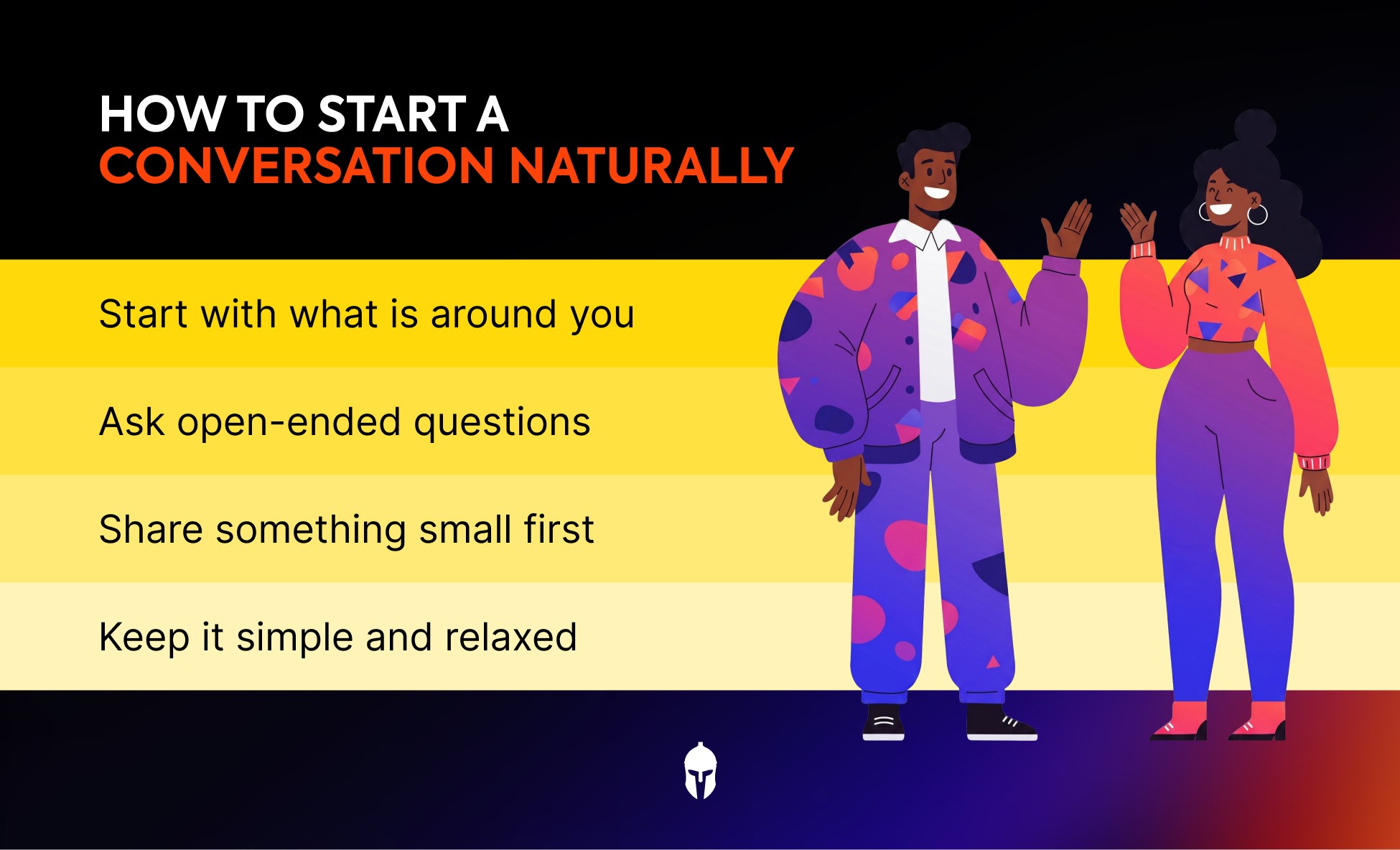
Share Something Small First
A brief personal comment before asking a question makes the exchange feel more balanced. Saying something simple such as “I have never been here before” or “That talk was better than I expected” creates openness without forcing the discussion too quickly. Small disclosures make the exchange feel mutual rather than one-sided.
Use Simplicity Instead of Performance
Simple openers usually work better than polished ones. Most people respond more comfortably to warmth and ease than obvious effort. Eric Edmeades emphasises a similar principle through his “Charisma Pattern” framework, where connection comes less from polished performance and more from presence, storytelling, and genuine engagement. A direct comment delivered calmly feels more natural than a line that sounds heavily prepared or designed to impress.
How Conversations Change Across Different Situations
The basics of starting a conversation stay consistent, but different environments create different expectations, levels of comfort, and social cues.

Starting a Conversation With Someone You Do Not Know
Simple comments connected to the situation usually work best with strangers. A brief observation, relevant question, or straightforward introduction feels easy to respond to. It creates familiarity gradually instead of forcing it too quickly. A comment about the queue, the event, the music, or something happening nearby often works better than a heavily prepared opener.
Starting Conversations at Work or Networking Events
Professional conversations work better when they move beyond small talk quickly. Genuine curiosity about what someone does, what they are building, or what they think about a topic creates more meaningful discussion. Questions such as “How did you get into that?” or “What are you focused on right now?” usually create more natural momentum than generic networking lines.
Starting Conversations Over Text
Messages rely more heavily on timing and clarity because tone and body language are absent. A simple message with clear context usually feels more natural than something overly planned or vague. Referencing a shared experience, recent event, or earlier discussion also makes the interaction feel more grounded and less abrupt.
Restarting a Conversation After Silence or Awkwardness
Most awkward moments pass more easily than people expect. Returning to the earlier topic, asking a follow-up question, or simply continuing forward is usually enough to recover naturally. What prolongs awkwardness is dwelling on it instead of continuing naturally.
Common Mistakes That Make Conversations Uncomfortable
Most uncomfortable interactions come from focusing too heavily on yourself instead of the exchange. Tension increases when too much attention goes into managing impressions, avoiding vulnerability, or controlling where the discussion goes.
Common mistakes include:
Asking too many questions without sharing anything in return. Conversations feel one-sided when one person reveals very little about themselves while expecting the other person to carry the discussion.
Trying too hard to sound interesting or impressive. People usually respond better to presence and sincerity than obvious performance.
Interrupting, rushing responses, or speaking without fully listening. Good interactions rely on rhythm, pauses, and showing genuine attention to what the other person said.
Forcing familiarity too quickly. Trust builds gradually through repeated positive experiences, not instant closeness.
Turning every exchange into a search for approval or reassurance. Discussions become draining when one side constantly needs validation from the other.
Most people do not remember whether every sentence was perfectly delivered. They remember whether the exchange felt comfortable, balanced, and easy to be part of.

How to Become Better at Conversations Over Time
Conversation skills improve through repetition, attention, and experience. Most do not become comfortable socially by waiting to feel confident first. Confidence usually develops after repeated interaction, not before it. Luke Chlebowicz speaks about a similar pattern in his discussion on discomfort and confidence, where growth comes from repeated exposure to uncomfortable situations rather than waiting to feel ready first. Each discussion makes the next one feel slightly more familiar and slightly less intimidating.
Improvement also depends on learning to pay closer attention. Strong communicators are usually good at noticing tone, pacing, interest, and emotional cues during a discussion. Listening carefully makes exchanges easier to navigate because it shifts focus away from self-consciousness and towards the other side.
Trying to manage every impression at once usually makes interactions feel more forced. Communication becomes more comfortable when less energy is spent performing and more focus goes into engaging honestly with the person in front of you. Social confidence becomes easier to develop when less energy is spent trying to appear confident and more energy is spent staying present.
Why Conversation Skills Matter Beyond Social Situations
Learning how to start a conversation confidently affects far more than social confidence. They shape trust, collaboration, leadership, and opportunity across both personal and professional life.
Many important opportunities begin through ordinary interactions that initially seem unimportant. Over time, the ability to connect comfortably with new people becomes a practical advantage in almost every environment.
Frequently Asked Questions